Saturday, February 21, 2009

VTS photos

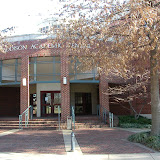
If anyone's interested in getting a glimpse of Virginia Theological Seminary, where one current (and hopefully one future) St. Francis House seminarian studies (will hopefully study), have a look at the album below. Sorry there aren't any actual people in these pictures; that's pretty much par for the course where my travel photography habits are concerned. I added the album to the SFH photo page as well.

My favorite historical tidbit from the weekend: Though located in Northern Virginia, VTS was occupied by the Union army during the civil war and used as a hospital. Apparently a few faculty members and some students literally went into exile in the mountains and continued to hold classes (many fought in the war, of course). While that's cool enough, I thought the most fascinating thing was that Virginia was partially rebuilt from $5,000 Union dollars that the dean at the time (treasonously) saved, as a way to hedge the school's bets (the rest of the money, in Confederate dollars, was of course useless after the war).

Virginia Theological Seminary

Thursday, February 19, 2009

That's a lot of tea and cookies...

So Chancellor Martin wants to start a really big book club. Aside from my frustration about the pronunciation ambiguity ("red" or "reed"?), I think it sounds like a great idea. Reading a book as a community establishes a set of shared referents like almost no other experience can, and one of the hardest things about talking to people from different backgrounds is the (perceived?) lack of such referents.

I don't envy whomever will have to make the final book decision (presumably Biddy herself in consultation with some committee), because any choice is likely to alienate as many people as it excites. As I was mulling over nomination ideas, it occurred to me that a book on religion--perhaps particularly on religious pluralism--might be an appropriate choice, given the state of the world and our bitter divisions. But how do you choose one that's appropriately imaginative, informative, challenging, fair, and rigorous? Is fiction or non-fiction a better incubator for discussion? Is topical even the way to go? (If so, would something about our nation or world's infrastructure, technological/scientific literacy, or financial, educational, or food systems be more timely?) Is there any hope of fostering a thoughtful and sensitive discussion on such a large scale (even via a large number of class-or-smaller-sized discussions)? What do you think?

Drop us a comment if you've got a book idea, religious or otherwise. And consider dropping Chancellor Martin a similar line here.

Saturday, February 14, 2009

On Anglicanism today

Finding truly good news stories, amidst the contagious gloom about the economy and frenzied obsession with the Obama presidency, can be a real challenge these days. Finding good coverage about the goings-on in the Anglican Communion is an even greater challenge - if you believe the BBC, notably, our in-house rivalries will drive us to extinction any day.

I was delighted, then, to find this article from the Atlantic, a biography of Rowan Williams that doubles as one of the fairest and - in my opinion - truest perspectives on the Anglican Communion to have crossed my RSS feed. It's a bit long (4 pages), but well worth reading.

Two excerpts that caught my eye:

1) "The Anglican Communion thrives on crisis and decline" - this in light of difficulties both past and present. It's an intriguing statement, and I think it drives home the reality that, while Anglicanism may be declining in numbers, it's hardly declining in spirit. I appreciate this affirmation that our many problems, far from causing our ultimate dissolution, create situations where dialogue and reconciliation can happen.

2) The author writes that the Archbishop "seemed to relish the limitations of his office." While I hear his opponents' complaints about his unwillingness to take decisive action in the Communion's internal struggle for power and authority, I can't help but think that we owe a great deal to his awareness of his limitations. I believe that his quiet, and deeply reflective style of leadership is responsible for the fact that Anglicans of all nationalities and value systems (barring a notable few) are still willing to call themselves by the same name. And I'm glad to see that view of him get some news coverage, for a change.
Thursday, February 12, 2009

Congratulations

I wanted to pass along a sermon link and some congratulations. The Rev. Gary Manning, Rector of Trinity Episcopal Church in Wauwatosa and friend to several of us in these parts, recently received Virginia Theological Seminary's 2009 John Hines Preaching Award. If you know Gary, you might want to send along your best--even though he probably won't want you too ;).

Either way, you should read his award-winning sermon (on Romans, chapter 6) if you have the time. I think you'll be glad you did.

Wednesday, February 11, 2009

Lenten Meditations

Higher Education Ministries at the national church sent us some information about this year's email-based Lenten meditations. If you're interested in receiving these meditations, send an email to mharewood@episcopalchurch.org with "join meditations" in the body.

Here's the blurb about this year's guide, The Transforming Moment by Bruce G. Epperly:
During Lent, we are called to journey into the wilderness with Jesus as our companion and guide. In the wilderness, we are confronted with the temptations of life in its complexity. In a society that routinely glorifies the seven deadly sins and uses temptation as a marketing device, it is easy to overlook the spiritually destructive, and often subtle, forms of temptation in our midst.

While we may recognize the obvious temptations of greed and lust, the more subtle temptations that infect our spiritual commitments may elude us. In recognizing our personal temptations, we gain the freedom to follow God fully and faithfully. Yet, we can face our temptations fully only when we trust that God is with us and that God will not abandon us in the wilderness of struggle and self-discovery. "Grace happens," for "while we still were sinners, Christ died for us."

"And our [Twitter feeds] shall proclaim your praise"

Shannon just sent me an interesting post about people using Twitter for regular daily prayer. I often say Noonday Prayer at my desk with the help of bcponline.org, but I suppose one of the benefits of this Twitter-based system is that it would keep me honest about doing so at the right times (rather than just working prayer time into my day when it's convenient for me, which in my opinion defeats some of the purpose). Unfortunately (or maybe not), I'm not so glued to my Twitter feed for that to actually happen in practice. Still, it's an interesting idea.

I am now following chrysostomhours, though, if for no other reason than that some of the prayers are quite beautiful (the current one is "O Lord, sprinkle on my heart the dew of Thy grace").

Monday, February 9, 2009

Editorial Philosophy?

I was listening recently to Bishop Steven Charleston, the Ethnic and Multicultural Minister for the Diocese of San Francisco and the new provost at Grace Cathedral, who was appearing for the first time on that church's excellent "weekly program of conversations and issues that matter" called The Forum (sound familiar?). I was really inspired by Bishop Charleston's Feb. 1 comments, and I wanted to share a short excerpt here because I thought they expressed a great vision for the vocation of the Episcopal Church (we get asked about that a lot) and perhaps also a useful editorial philosophy for this blog. I encourage you to check out the podcast, which is currently available at the above link and will probably soon move to the archives here. (Incidentally, Bishop Charleston is a hell of a preacher as well, and you can also catch his sermon from that day.) These comments came around the twenty minute mark:

Why is there an Episcopal Church? What's the point? Why are we here? Listen, I've thought about this and I'll tell you something. I believe that the Episcopal Church, the Anglican Communion, is here not by accident. We didn't just happen; we're here for a reason and for a purpose. We follow a God of history, do we not? We follow a God that we say is a God who intervenes and acts within time and space in the lives of real human beings to effect change, to make something happen. And that all of us play a part in it.

What's the part the Episcopal Church is playing? Why are we here? I believe it is because the Episcopal Church, the Anglican Communion as I said, represents common ground where men and women can actually come and believe that it is possible for them to hold very different opinions, and live very different lifestyles, and still have a common ground where they can live in reconciliation and peace with one another and share for the common good.

I believe the Episcopal Church was created for this purpose and for this moment in time and history. Pardon me if I wax a little metaphysical on you, but as a Bishop of this church I've staked me life on it. And I'm here to say to you, in all honesty, I believe we were made for this moment. I believe we're the church made for crisis. We're the church that is prepared for conflict. We're the church that understands what it means to live in a moment like this, when people are anxious and afraid because things around them seem to be falling apart.


I'm always a little wary of blog posts where the quotation is longer than the accompanying analysis, but I'm afraid there's not much else I can add to that. Except maybe to say thanks to Bishop Charleston for articulating the intermingled hopes and anxieties that I think many of us around here are feeling. And to encourage you to check out the whole podcast.